

TB-500 (Thymosin Beta-4)
1. Executive Summary
TB-500 is the synthetic version of Thymosin Beta-4 (Tβ4), a naturally occurring peptide found in almost all human and animal cells. It plays a fundamental role in cell structure, repair, and mobility.
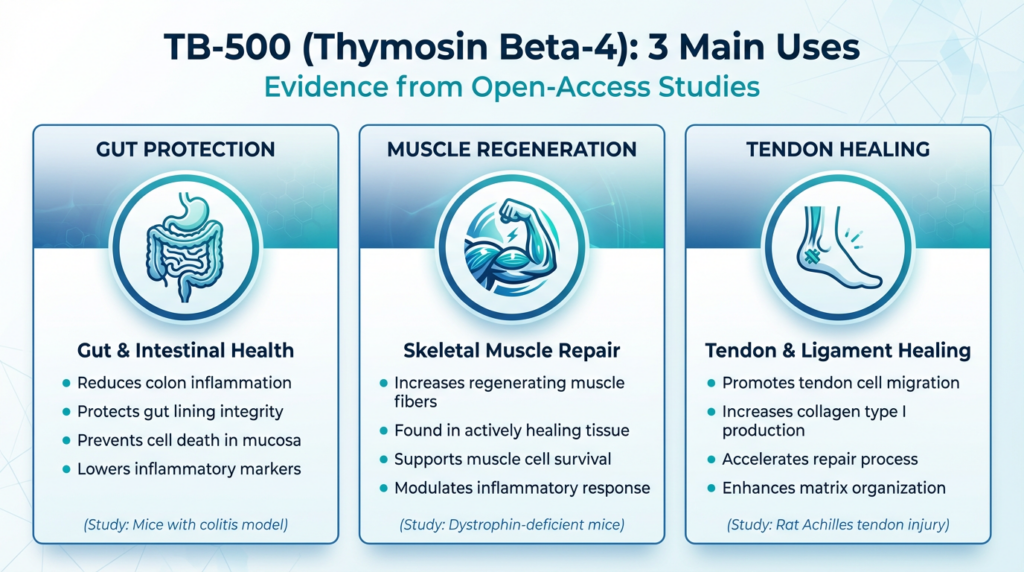
In scientific literature, this peptide is primarily studied for its ability to regulate actin—a protein essential for cell movement. By upregulating actin, TB-500 may help cells migrate to sites of injury to initiate repair. The research summarized below highlights its potential roles in three distinct areas: healing the intestinal lining (gut health), regenerating skeletal muscle fibers, and promoting the development of tendon tissue.
2. Primary Research Studies
Study 1: Gut & Intestinal Protection
Journal: World Journal of Gastroenterology / PubMed Central (PMC)
Plain-Language Title: Reducing Inflammation and Promoting Healing in Colitis (IBD)
What was tested: Researchers used a mouse model of colitis (severe inflammation of the colon, similar to Ulcerative Colitis or Crohn’s disease in humans). They administered Thymosin Beta-4 directly to the colon to see if it could protect the gut lining from damage caused by harsh chemicals.
Key Findings:
- Reduced Tissue Damage: Mice treated with Tβ4 showed significantly less damage to the colon tissue compared to untreated mice. It helped preserve the structural integrity of the gut lining.
- Anti-Inflammatory Action: The peptide significantly lowered levels of inflammatory markers (such as MPO, TNF-α, and IL-1β) that typically drive the disease.
- Cell Survival: Tβ4 prevented cell death (apoptosis) in the mucosal lining of the gut, helping to maintain the barrier against bacteria.
Clinical Relevance: This study suggests that TB-500/Tβ4 has potent anti-inflammatory properties specific to the gastrointestinal tract and may help heal the mucosal lining in conditions like Inflammatory Bowel Disease (IBD).
Study 2: Muscle Regeneration
Journal: PLoS ONE (2010)
Plain-Language Title: Stimulating Muscle Fiber Regeneration in Dystrophy
What was tested: This study looked at “mdx” mice, which have a genetic defect causing muscular dystrophy (similar to Duchenne Muscular Dystrophy). These mice were treated chronically with Thymosin Beta-4 for 6 months to see if it could repair wasting muscle tissue.
Key Findings:
- Increased Regeneration: The most significant finding was a clear increase in the number of regenerating skeletal muscle fibers in the mice treated with Tβ4.
- Localization: When researchers stained the tissue, they found Tβ4 specifically located within these regenerating fibers, confirming it plays a direct role in the repair process.
- Limitations: While it successfully stimulated repair pathways (regeneration), in this specific severe genetic model, it did not fully restore grip strength or reverse established scarring (fibrosis) during the trial period.
Clinical Relevance: This confirms that TB-500 signals muscle tissue to enter a “repair mode” and generate new fibers, although functional recovery may depend on the severity of the underlying condition.
Study 3: Tendon Tissue Engineering
Journal: Materials Science and Engineering: C (2019)
Plain-Language Title: Helping Stem Cells Become Tendon Tissue
What was tested: This was a laboratory (in vitro) study. Scientists created special microscopic scaffold yarns loaded with Thymosin Beta-4. They placed human stem cells (from fat tissue) on these scaffolds to see if Tβ4 would help them grow into tendon cells.
Key Findings:
- Enhanced Migration: Tβ4 acted as a signal that attracted stem cells, encouraging them to migrate onto the scaffold structure.
- Tenogenic Differentiation: The peptide encouraged the stem cells to differentiate (transform) specifically into tenocytes (tendon cells).
- Gene Expression: Cells exposed to Tβ4 showed higher levels of specific genes required for building healthy tendon tissue.
Clinical Relevance: This provides evidence that TB-500 is not just for muscle; it actively supports the recruitment and development of tendon cells, which is critical for healing injuries like tendonitis or tears where blood flow is usually poor.
3. Key Takeaways
Based on these three studies, TB-500 (Thymosin Beta-4) appears to function through three main mechanisms:
- Cytoprotection: It protects existing cells from damage and death (as seen in the gut study).
- Anti-Inflammation: It lowers key inflammatory chemicals that cause tissue destruction.
- Cell Migration & Differentiation: It acts as a signal to attract stem cells and repair factors to the site of injury, facilitating the growth of new muscle or tendon tissue.
4. Important Safety & Regulatory Note
Most research on TB-500/Thymosin Beta-4 is pre-clinical (conducted in animals or cell cultures). While it is a naturally occurring peptide, the synthetic version is currently considered an investigational compound in many jurisdictions and is not FDA-approved for general human use as a dietary supplement or drug. Users should consult with a medical professional regarding legal status and safety profile.
5. References
- Gut Study: Recombinant adeno-associated virus carrying thymosin β4 suppresses experimental colitis in mice.
https://pmc.ncbi.nlm.nih.gov/articles/PMC5236504/ - Muscle Study: Evaluation of Skeletal and Cardiac Muscle Function after Chronic Administration of Thymosin β-4 in the Dystrophin Deficient Mouse.
https://journals.plos.org/plosone/article?id=10.1371/journal.pone.0008976 - Tendon Study: Electrospun Thymosin Beta-4 Loaded PLGA/PLA Nanofiber/Microfiber Hybrid Yarns for Tendon Tissue Engineering Application.
https://www.sciencedirect.com/science/article/pii/S0928493119317837