

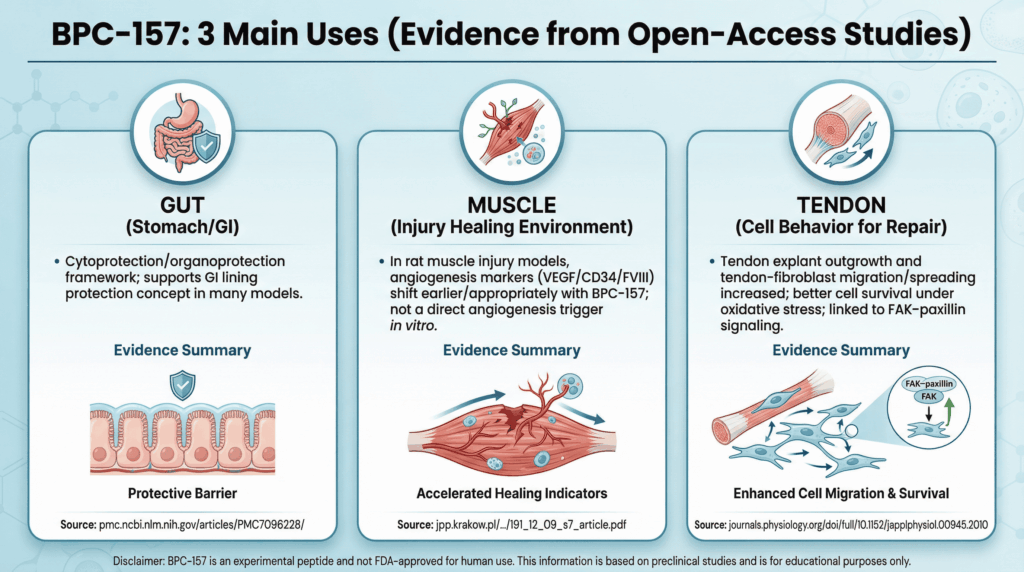
What this is (who it’s for): A plain‑language summary of three open‑access scientific papers on BPC‑157—one about stomach/gut protection and two about muscle/tendon healing. This is for general education (not medical advice).
Quick glossary
Cytoprotection: helping cells withstand injury and recover afterward.
Fibroblasts / tendon fibroblasts: repair-focused cells that help rebuild connective tissue like tendons.
Angiogenesis: the process of making new small blood vessels, which often supports healing.
Article 1 (Gastric / Gut focus)
1) Stable Gastric Pentadecapeptide BPC 157… (Review)
Open-access link: https://pmc.ncbi.nlm.nih.gov/articles/PMC7096228/

Figure from the gut review (cytoprotection/organoprotection framework).
What question does it ask?
How could BPC‑157 function as a stomach/gut protective (and broader ‘organ‑protective’) peptide, and what evidence supports that idea?
What kind of study is it?
A review article (it summarizes many prior experiments; it is not one new clinical trial).
What did they do (high level)?
The authors compile and interpret prior studies describing BPC‑157’s reported effects on the stomach lining, GI tract, and related systems (blood vessels, inflammation, healing models).
Main takeaways / benefits reported (plain language)
• Describes GI lining protection against multiple types of injury in various models.
• Discusses possible roles related to blood vessel/endothelial function and nitric oxide (NO) signaling, which are often relevant to healing.
Important limitations / caveats
• Because it’s a review, conclusions depend on the quality and reproducibility of the underlying studies.
• It does not, by itself, establish strong clinical proof of benefit for patients.
What this means for humans
This paper supports biological rationale and summarizes preclinical evidence. It should not be read as proof that BPC‑157 treats gut conditions in humans.
Article 2 (Tendon healing focus)
2) The promoting effect of pentadecapeptide BPC 157 on tendon healing… (Mechanism study)
Open-access link: https://journals.physiology.org/doi/full/10.1152/japplphysiol.00945.2010
[Image not embedded due to download restriction: https://journals.physiology.org/cms/10.1152/japplphysiol.00945.2010/asset/images/medium/zdg0011193830001.jpeg]
What question does it ask?
What might BPC‑157 do to tendon cells that could help explain tendon healing—especially cell outgrowth and movement into an injury site?
What kind of study is it?
A lab mechanistic study using rat Achilles tendon explants and tendon fibroblast cultures (not a human clinical trial).
What did they do (high level)?
They exposed tendon explants / tendon fibroblasts to BPC‑157 and measured outgrowth from tendon tissue, survival under oxidative stress, migration/spreading, and activation of movement-related signaling proteins (FAK/paxillin).
Main takeaways / benefits reported (plain language)
• Faster cell outgrowth from tendon explants.
• Better tendon cell survival under oxidative stress.
• Increased tendon fibroblast migration/spreading; linked to activation of the FAK–paxillin pathway.
Important limitations / caveats
• Cell/explant experiments do not capture the full complexity of a living organism.
• Improved cell behaviors do not automatically translate into better patient outcomes.
What this means for humans
This paper is strongest for explaining a possible mechanism (cell migration/survival) rather than proving clinical effectiveness in people.
Article 3 (Muscle + tendon healing; angiogenesis focus)
3) Modulatory effect of gastric pentadecapeptide BPC 157 on angiogenesis in muscle and tendon healing (Animal models + cell assay)
Open-access PDF: https://jpp.krakow.pl/journal/archive/12_09_s7/pdf/191_12_09_s7_article.pdf
What question does it ask?
Does BPC‑157 influence blood‑vessel‑related healing (angiogenesis) during recovery from muscle and tendon injury—and is that effect direct on endothelial cells or mainly seen in living tissue?
What kind of study is it?
Mixed design: an in vitro endothelial tubule assay plus in vivo rat injury models (muscle crush, muscle transection, Achilles tendon transection) with staining for angiogenesis-related markers (VEGF/CD34/FVIII).
What did they do (high level)?
They compared BPC‑157 vs saline after injuries and tracked marker changes over time; they also tested whether BPC‑157 directly drives endothelial tubule formation in vitro.
Main takeaways / benefits reported (plain language)
• No clear direct pro-angiogenic effect in the in vitro tubule assay.
• In living rats, marker patterns suggested earlier and more ‘appropriately timed’ angiogenesis during healing.
• Authors interpret this as an ‘angiomodulatory’ role (supporting/regulating healing-related vessel activity), not a simple on/off angiogenesis trigger.
Important limitations / caveats
• Animal models and marker patterns do not prove benefit in humans.
• Angiogenesis is only one part of healing; strength/function outcomes in people remain uncertain.
What this means for humans
If the effect is real, it may depend on whole-body healing signals (injury + inflammation + blood flow) rather than direct stimulation of endothelial cells alone. Still preclinical evidence.
Side-by-side comparison
Bottom line
Across these three papers, the most consistent preclinical themes are gut protection framing (cytoprotection) and musculoskeletal healing signals involving cell migration/survival and healing-associated vascular signaling patterns. Strong human clinical proof is not established by these three papers alone.
Safety / regulatory note
BPC‑157 is widely discussed as an investigational/research compound. Much of the accessible evidence is preclinical. This document is educational only and does not provide medical advice or dosing guidance.
References (open access links)
1) https://pmc.ncbi.nlm.nih.gov/articles/PMC7096228/
2) https://journals.physiology.org/doi/full/10.1152/japplphysiol.00945.2010
3) https://jpp.krakow.pl/journal/archive/12_09_s7/pdf/191_12_09_s7_article.pdf